
Material Science
The Alchemy of Paint: Pigment, Binder, and the Craft of Longevity
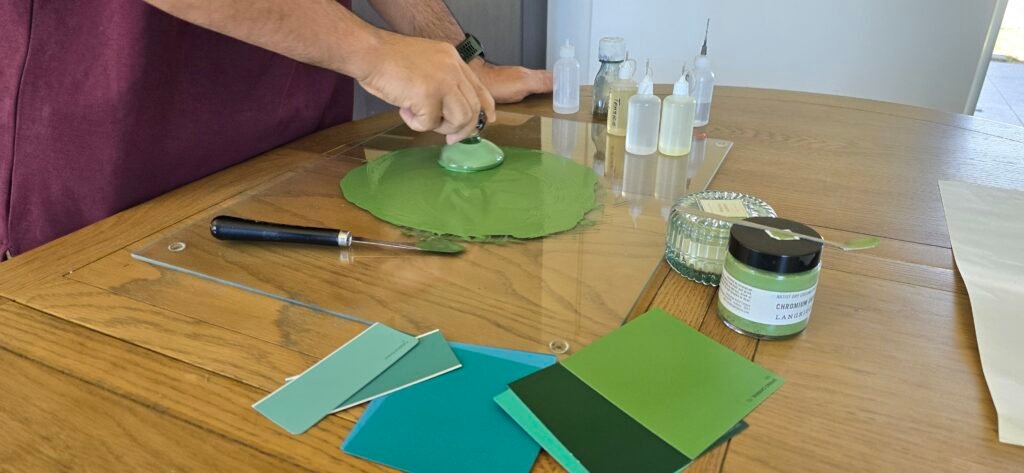
When examining a painting, the eye is naturally drawn to the image, the sweep of a line, the geometry of a pattern, and the interplay of colour. Yet beneath the visual narrative lies a precise physical structure. Whether looking at a historic manuscript or a contemporary piece crafted in gouache and gold, every painting relies on a universal, tripartite architecture.
To truly understand material behaviour and the longevity of an artwork, one must look past the hue itself and consider the chemistry. This delicate balance of three components has remained constant for millennia.
1. The Pigment (The Foundation)
The heart of any paint is its pigment. These are insoluble, finely divided solid particles that provide colour and opacity.
Unlike dyes, which dissolve entirely in liquids and stain a surface, pigments remain suspended and settle onto a surface like fine sand in water. This insolubility allows them to sit gracefully atop handmade paper or canvas, creating a structural layer rather than a chemical stain.
This component connects contemporary practice directly to historical lineage. For centuries, artisans have understood how to manipulate these raw materials. Renaissance and Persian workshop artists alike learned to roast raw earth pigments, chemically transforming raw sienna into the deeper, warmer resonance of burnt sienna.
Conservation Note: Pigment is the primary determinant of lightfastness. If a pigment is chemically unstable under UV light, no amount of careful framing or varnish will prevent fading. This is why historically tested mineral and earth pigments remain the standard for archival longevity.
2. The Binder (The Anchor)
If one were to spread dry pigment onto a sheet of paper, a mere breath would scatter it. An adhesive or binder is required to secure it.
The binder surrounds the microscopic pigment particles, holding them together and anchoring them to the painting surface. Crucially, it is the binder that determines the distinct nature and classification of the paint:
- Gum Arabic: Used in gouache and watercolour.
- Linseed or Walnut Oil: Used in oil painting.
- Acrylic Polymer: Used in modern acrylics.
Conservation Note: The binder provides structural integrity over time. If a binder is too brittle, the painted surface will eventually crack. If it yellows as it ages, a common issue with inferior oils, the entire colour harmony of the piece will subtly shift.
3. The Vehicle (The Flow)
To transfer pigment and binder from the palette to the paper, the mixture requires a temporary liquid to adjust its consistency and allow it to flow from the brush.
This liquid is known as the vehicle (or solvent). Its function is entirely transitional; once the paint has been applied, the vehicle evaporates, leaving only the pigment and binder bound to the surface. In oil paint, the vehicle is traditionally a solvent like turpentine. In gouache and watercolour, it is simply water.
The Chemistry of Archivability
A structurally sound paint is a delicate, precise balance of these three elements. When artists mix their own paints or adjust commercial formulations, they must navigate the risks of structural failure:
- Under-bound (Excess Pigment): When there is insufficient binder to encapsulate the powder, the resulting surface is beautifully matte but highly vulnerable. The paint may “chalk” or dust off upon light contact.
- Over-bound (Excess Binder): When the ratio leans too heavily towards the adhesive, the paint becomes gummy or excessively glossy. In media like gouache, excessive gum arabic can cause the surface to shrink and crack as water evaporates.
Material Comparison Table: The Paint Family Tree
| Medium | Primary Binder | Vehicle / Solvent | Surface Finish | Archival Characteristics |
|---|---|---|---|---|
| Gouache | Gum Arabic | Water | Velvety, opaque matte | Highly stable colour; remains water-soluble; sensitive to high humidity. |
| Watercolour | Gum Arabic | Water | Transparent | Relies entirely on the white of the paper for luminosity; stable if pigments are lightfast. |
| Oil Paint | Linseed / Walnut Oil | Mineral Spirits / Turpentine | Variable (Gloss to Satin) | Highly durable; cures by oxidation rather than evaporation; prone to slow yellowing over decades. |
| Acrylic | Acrylic Polymer Emulsion | Water | Satin to Gloss (Plastic-like) | Highly flexible; rapid drying; cannot be reactivated once cured. |
Observing the Craft
Understanding the studio’s chemistry deepens our reverence for the handmade object. When standing before a work at Nilpar Gallery, you are not merely looking at an image; you are witnessing a suspended physical balance of pigments anchored by natural resins to warm, fibrous paper, stabilised by the artist’s hand to endure for generations.
Looking past the narrative of an artwork to see its material reality invites a quieter, more profound appreciation of the craft that makes it possible.