
Material Science
The Alchemy of Gold: Karats, Burnishing, and Light
When a viewer encounters a contemporary Persian painting, the immediate, visceral response is often driven by the presence of gold. It commands the eye, radiating outward in a measured rhythm across the warm, fibrous landscape of handmade paper. Yet, to view gold merely as a luxurious decorative element is to misunderstand its fundamental nature in the studio. In fine art, a line drawn in gold on handcrafted paper is not a reference to a tradition; it is an act within one. It is a precise manipulation of material science and optics.
Following our exploration of how sized cotton rag acts as a structural foundation for paint, we must turn to the most revered of all studio materials. To master 24-karat gold leaf is to move beyond the chemistry of pigments and enter the physics of light.
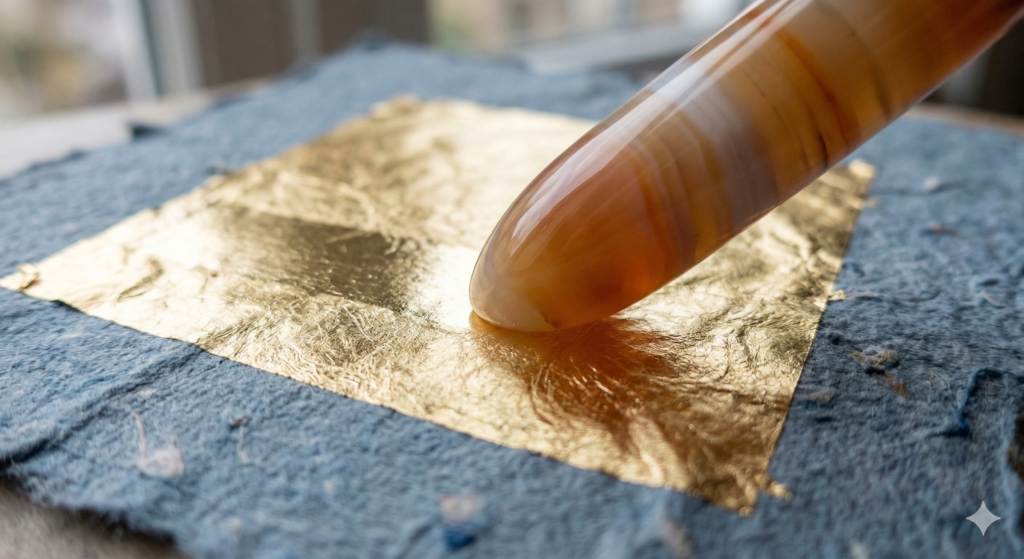
[IMAGE STRATEGY: A tight, macro-lens photograph showing a polished agate burnishing tool resting on a partially burnished sheet of 24k gold leaf applied to blue-ish handmade paper. Alt-text: A close-up of an agate burnisher pressing into 24-karat gold leaf on textured handmade paper, revealing the contrast between matte and mirror-like finishes.]
The Physics of the Karat and the Substrate
Unlike standard earth or lake pigments, which are finely ground particles suspended in a binder, gold leaf is a continuous, solid metal. For archival fine art, 24-karat gold is the absolute standard, not merely for its cultural prestige, but for its chemical inertness. Pure gold does not oxidise; it will not tarnish, darken, or decay when exposed to the atmosphere over centuries.
When a master artisan applies this microscopically thin metal to the paper, it requires a meticulously prepared surface. The sizing of the handmade paper, the gelatin or starch matrix that fills the microscopic gaps between the cotton fibres, acts as the foundational bed. A delicate adhesive (often garlic juice, traditional glair, or a specialised gold size) is applied to this prepared surface. Once the leaf is laid down, it sits atop the paper in a fragile, matte state. In this unworked condition, the microscopic surface of the gold is uneven, scattering incoming light in multiple directions, much like a highly opaque earth pigment.
The Mechanics of Compression
To transform the metal from a dull yellow layer into a luminous, reflective surface, the artist must perform the physical act of burnishing. Using a polished, densely formed stone, historically an agate, hematite, or shaped animal bone, the artist applies firm, rhythmic pressure directly over the gold.
This is where the material science of the metal shifts dramatically. Because 24k gold is highly malleable, the pressure of the agate tool physically compresses the gold lattice. It flattens the microscopic peaks and valleys of the metal into a perfectly smooth, continuous mirror.
While a flat, opaque pigment like yellow ochre scatters light based on its refractive index, burnished gold interacts with light directionally. It captures ambient light and reflects it sharply back to the viewer. This compression not only alters the optical behaviour of the gold but physically forces it deeper into the sized fibres of the cotton rag, ensuring an incredibly strong, archival bond between metal and substrate.
Material Comparison Table: The Behaviour of Light and Gold
| Material State | Physical Structure | Light Interaction | Archival & Aesthetic Finish |
| Yellow Ochre (Pigment) | Particulate powder suspended in gum arabic | Scatters light (refraction); appears the same from all viewing angles. | Velvety, opaque matte; structurally anchors the composition. |
| Unburnished 24k Gold Leaf | Microscopically thin, continuous metallic sheet with an uneven microscopic topography | Scatters light diffusely; appears as a soft, matte yellow. | Fragile surface; lacks the optical depth of polished metal. |
| Burnished 24k Gold Leaf | Compressed, flattened metallic lattice forced into the paper’s sizing | Directional reflection; acts as a mirror, creating high-contrast flashes of light. | Highly durable, dense, solid shine; inert and immune to atmospheric oxidation. |
| Shell Gold (Gold Pigment) | Ground gold powder mixed with a water-soluble binder | Soft, sparkling reflection; sits like a wash rather than a solid mirror. | Delicate, luminous glaze; used for fine detail rather than structural geometry. |
Observing the Craft
The true magic of burnished gold lies in its relationship with the viewer’s movement. Unlike a standard pigment, which remains static regardless of where you stand in the room, burnished gold is kinetic.
When you observe a contemporary piece at Nilpar Gallery, walk slowly past the frame. You will notice the illuminated nodes and precise focal points the Negin and Shamsa motifs suddenly flash with light, only to fall into deep, warm shadow as your angle changes. This suspended physical balance transforms a static two-dimensional pattern into a living, shifting architecture. You are witnessing the enduring memory of the agate tool, compressing light and metal into the very fibres of the paper.