
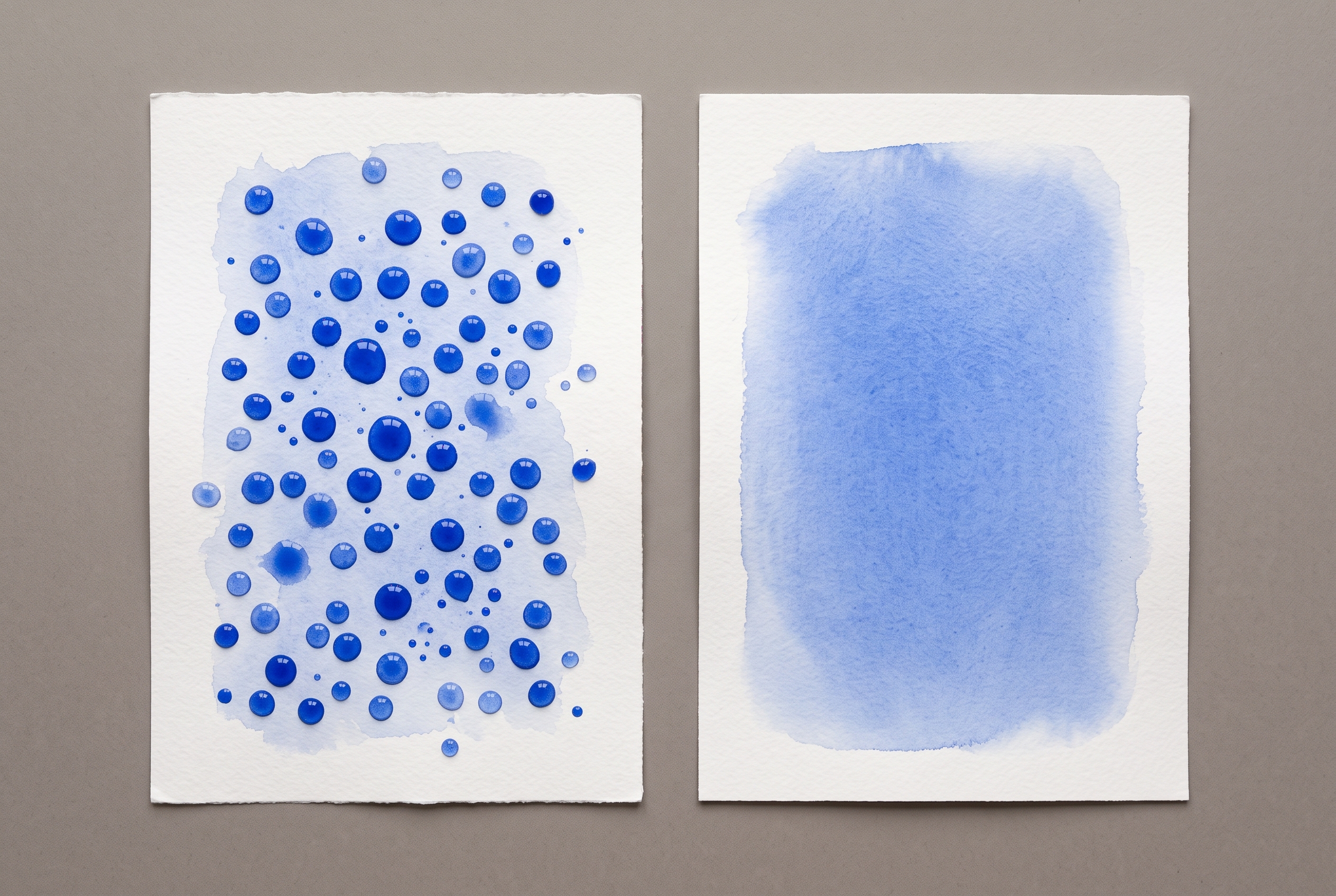
A binder that never stops being soluble
The defining property of watercolour is that its binder remains water-soluble
after it has dried. A dried pan can be rewetted and used; a dried acrylic
cannot.
This is a formulation choice rather than an inevitability, and it has
consequences in both directions. It is what makes pans possible, what allows a
passage to be lifted or softened after the fact, and what allows a subsequent
wash to disturb the one beneath it.
Gouache differs from watercolour principally in solids loading rather than in
binder chemistry. Higher loading gives opacity and the characteristic flat
matte surface; the binder is doing the same job in both.
The components that shape a wash
|
Component class |
What it governs |
|---|---|
|
Water-soluble binder |
Adhesion; rewetting; solubility of the dry film |
|
Humectant |
Retention of moisture; ease of rewetting; open time |
|
Plasticiser |
Flexibility of the dry film; resistance to cracking in a pan |
|
Wetting agent |
How a wash spreads rather than beading on the paper |
|
Extender |
Opacity and body, particularly in gouache |
Two of these deserve emphasis because they are so often attributed elsewhere.
A pan that rewets readily and one that resists is usually a difference of
humectant, not of pigment or of age. And a wash that spreads evenly rather
than gathering into beads is behaving as a wetting agent allows it to; the
same pigment in a formulation without one behaves quite differently on the
same paper.
Paper is the other half
No account of a wash is complete without the surface receiving it.
A watercolour paper’s sizing governs how far and how fast water penetrates,
and therefore whether a wash sits on the surface and dries evenly or is drawn
in and dries with hard edges. Sizing is itself variable and is not disclosed
in comparable terms.
So the behaviour a painter observes is a joint property of a formulation and a
sheet, and attributing it to either alone will mislead.
The limits are the usual ones, and they bite hard here. Component identity and concentration are proprietary and undisclosed for artists’ products. Reformulation occurs without announcement, so a product-level statement decays with time.
There is also no published comparison of humectant and plasticiser systems
across artists’ watercolour ranges, and the long-term behaviour of a film whose
binder remains soluble — including how humectant content affects it over
decades — is not characterised.
What can be said is the structural point. In watercolour, more than in any
other medium, the handling is the formulation. A colour that behaves
differently from another of the same name is not a different pigment. It is a
different set of the components above.
Humectants and Plasticisers and Surfactants, Defoamers and Wetting Agents
cover two of those classes in their own right.