A Disc Left Almost Empty
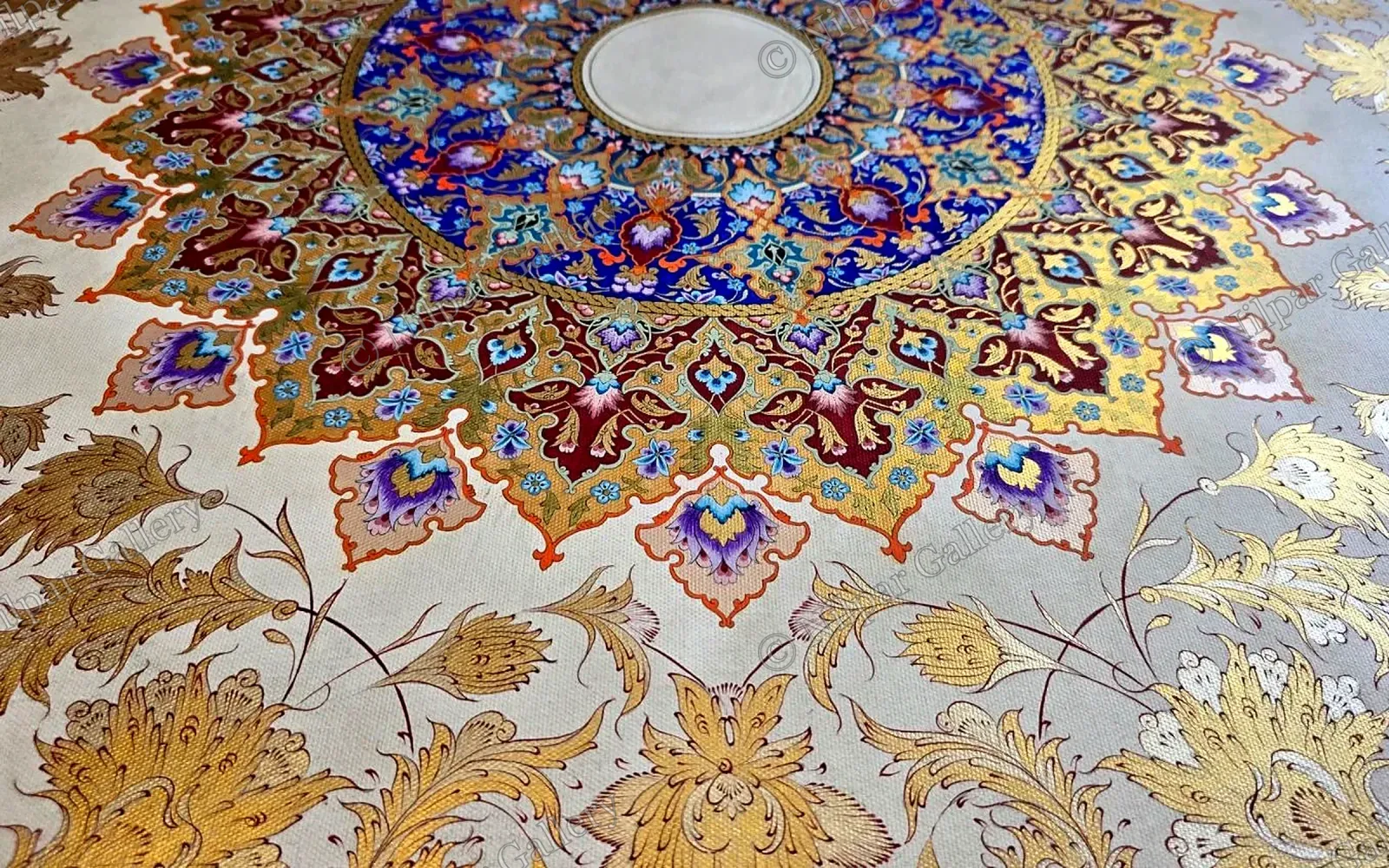
At the centre of The Gracious Garden there is a small disc of pale ground, ringed in gold and left almost empty. Everything else moves out from it: a ring of deep blue, a crown of gold and crimson points, and then a wide ivory field where gold and silver blossoms drift on fine red stems. Anyone who knows Persian carpets will recognise the design at once. For me, it is also a courtyard I am trying to remember.
A Carpet Design
The artwork follows the design and proportions of a Persian carpet, inspired in particular by the gardens and geometry of Isfahan carpets. A central medallion holds the field. Two small cartouches sit above and below it on the vertical axis. Four lobed corner fields close in from the corners. A narrow band of braided gold runs around all of this, and beyond it a wide border of gold and silver foliage fills the outer margin.
I worked on it from March to September 2026, on canvas mounted on an aluminium composite panel, at 150 by 100 centimetres. The colour is acrylic. The gold is a metallic gold mica, and the silver is real silver. Up close the weave of the canvas shows through everything, the ivory ground and even the densest passages of gold, so each one carries a faint woven texture of its own.
Nothing in the design is a picture of a place. There is no house drawn here, no pool, no window. But for me, this carpet is a courtyard held in memory.
The Pool
The medallion is a Shamseh, and it radiates, pulling outward from its centre. For me, it became a pool, the heart of the garden. Its inner ring is a deep blue field filled with blooms in lilac, mauve and pale turquoise, joined to one another by continuous scrolling stems, with small touches of orange-red inside the blue. When I look at it, I think of clear water and the colour of glazed tiles beneath the surface.
A twisted gold band, drawn like a rope, holds the blue in place. Outside it the Shamseh opens into pointed lobes on a gold ground, each carrying a crimson floral form edged in gold. These jewel-like reds became pots of flowers around the edge of the pool. Beyond the tip of each point, separated by a thin margin of ivory, floats a small pale pink cartouche with a single mauve and turquoise bloom, free of the medallion and still belonging to it.
The House Around It
In my mind, the corner fields are the house: rooms gathered closely around a shared space, windows filled with coloured glass, doors opening onto the courtyard, rooms belonging to different generations of the same family. They are not drawn as buildings. They are lobed fields on a gold ground, their scalloped edges traced in a thin orange-red line, filled with blooms in pink, lilac and crimson among olive-green leaves and scrolling stems. But they close in around the open centre the way rooms close around a courtyard, and that is how I see them.
This is what I miss about Iran. I do not only long for a landscape or a particular house. I long for a way of living, for homes where lives unfolded together, where children, parents and grandparents moved through one another's days. A courtyard was never simply an empty centre. It held voices, meals, arguments, celebrations, afternoon tea, the sound of water, the scent of flowers, and the quiet rituals of ordinary life.
There is something beautiful to me about imagining how many lives a house can remember. One generation leaves and another arrives, yet traces remain: a tree planted by someone long gone, a favourite place beside the pool, a window opened every morning, stories repeated until nobody quite remembers who first told them.
Flowers Changed by Memory
Most of the colour in the artwork sits in the pool and in the corner fields. Across the open field between them, the blossoms and long serrated leaves are gold and silver, with their stems, veins and finest edges drawn in dark red line. There is almost no other colour there.
The flowers are golden because memory has changed them. They are no longer ordinary flowers; they carry affection, absence and the glow that things sometimes acquire when they are far away. Some of them are silver, and the silver is the moon: it is the same garden at night, under moonlight. The gold and the silver grow side by side through the whole field.
The gold and silver never look the same twice. They answer to the light and to where you are standing. Gold mica pigments are typically built on thin flakes of mica carrying a fine, highly refractive coating, and their glow depends on those flakes lying flat and parallel to the surface. From one side the silver blossoms flare almost white while the gold beside them sinks to a deep honey brown. Take a step and the pattern of bright and dark rearranges itself. Memory works like that for me: the same place, held a little differently every time I return to it.
I imagine walking through these flowers, sitting beside the pool and placing my feet in the cool, clear water, looking down at the coloured tiles beneath the surface, while light passes through stained-glass windows and scatters colour into the rooms.
Beyond the Walls
The braided gold band is the wall: narrow, orderly, a guard line of repeating interlace. In a carpet, the border outside it is a frame. Here I let it become something else. Beyond the wall the gold and silver foliage begins again, denser than in the courtyard, pressing right to the edge, as if life and memory cannot be contained by any boundary.
A Home Built From Memory
It is an imagined place, but the longing in it is real. The artwork is about the home I miss: not one exact building or one exact moment, but a whole world of shared lives, familiar beauty and belonging. It is built from memories inherited from others, memories of my own, and perhaps even memories of things I never lived but still feel connected to.
In a room, it changes with the day. Morning light raking across the surface wakes the gold and silver; in the softer light of evening the gold settles and the silver turns to moonlight, and the blue of the pool and the crimson of the flowerpots hold the garden together. At its centre the pale disc stays open, as a courtyard does, for whoever comes to sit beside the water. It is a garden where generations remain present, and where everything I miss has been allowed to grow again.