
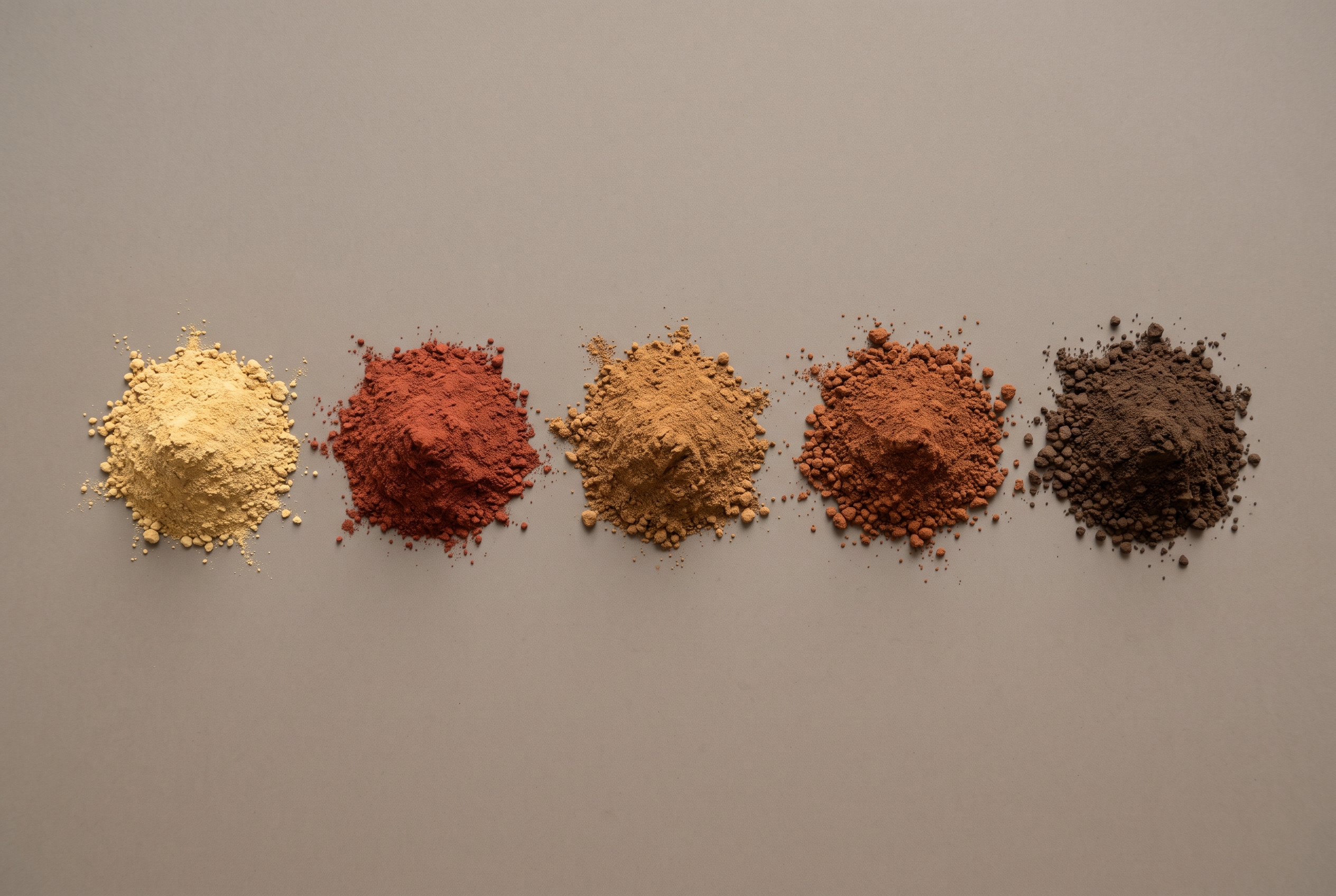
Names were doing a different job
A modern chemical name is designed to identify a compound uniquely. A historical colour name was designed to do something else, and usually several things at once.
Some names describe appearance: a colour, a depth, a comparison to something familiar. Some describe source: a mineral, an organism, a place of origin, a port of shipment. Some describe trade: a grade, a price band, a supplier’s designation, a quality within a merchant’s range. Some describe preparation: how the material was made or refined, which distinguishes products that share a raw material. Some are honorific or associative, attaching a place or a person to a material for reasons that have nothing to do with its composition.
None of these logics produces a one-to-one mapping onto chemistry, and most historical names carry more than one at once. A term that names a port tells you where a material was bought, not what it was; the same port handled several materials, and the same material arrived through several ports. A term that names a grade distinguishes two products that may be chemically identical.
So ambiguity is not a defect in the historical record. It is the record working as designed, for purposes that were commercial, practical and descriptive rather than analytical. The problem arises only when a modern reader asks the name a question it was never constructed to answer.
Five things a colour word can be
Most confusion in this area dissolves once you keep five distinct entities apart, and most careless statements can be diagnosed as a slide between two of them.
A historical term is a word in a language, used in a place, at a date, within a trade or a craft. Its referent is whatever its users meant by it, established by context, parallel sources, and the objects associated with it.
A substance is a material with a composition and a structure. It exists independently of what anyone calls it, and it can be described analytically.
A preparation is a process applied to a substance: washing, levigating, roasting, precipitating, grading, combining with a carrier. Two products of the same raw material can differ substantially in behaviour because their preparations differed, and historical trade often distinguished them by name.
A product is what was actually supplied — a substance, prepared in a particular way, sold under a particular name, at a particular grade, by a particular supplier, at a date. It is the entity a historical purchaser encountered.
An object assertion is a statement that a specified material is present at a specified location in a specified work, supported by a stated method at a stated confidence.
The five are linked, and the links are the interesting part. What they are not is interchangeable. A sentence that begins with a term and ends with an object assertion has crossed four boundaries, and each crossing needs its own evidence.
|
Entity |
What it is |
What establishes it |
The commonest slide |
|---|---|---|---|
|
Historical term |
A word in a language, used in a place, at a date, within a trade or craft |
Context, parallel sources, and the objects associated with its use |
Read as though it named a compound |
|
Substance |
A material with a composition |
Analysis, or a documented deposit or synthesis |
Assumed from the term alone |
|
Preparation |
What was done to the substance before use |
Recipes, workshop evidence, physical traces |
Collapsed into the substance |
|
Product |
A specific thing supplied under a name |
Trade records, supplier documentation, formulation |
Assumed to equal the substance |
|
Object assertion |
A claim about one particular work |
Examination of that object, with its limits recorded |
Inferred from any of the four above |
How the ambiguity actually arises
Several distinct mechanisms produce the ambiguity, and naming which one is at work usually clarifies the case.
A colour-descriptive term covering several chemistries. The earth pigment names are the largest family: terms in the ochre, sienna and umber groups describe iron-bearing earths whose exact composition, and in the case of the umbers their manganese content, varies with the deposit. The name records a colour and a general class, not a formula.
A term attached to a place that later travelled. Names formed from a place of origin or of manufacture routinely outlive the connection. Materials associated with Naples and with Berlin acquired names that continued in use long after production had dispersed, and in the Berlin case a second name from another market denotes the same material.
A term transferred to a replacement. When a new material took over an older one, the older name often came with it. The modern trade convention of appending hue to a traditional name to indicate a substitute formulation is the formalised, honest version of a practice that operated informally for centuries and often without notice.
A term whose referent split. Ultramarine named a single expensive material extracted from lapis lazuli until a synthetic route was established in the 1820s, after which the same word covered two materials of the same essential colour, very different cost and distinguishable analytical signatures. The word did not change; what it could pick out did.
A term whose material history is itself contested. Some famous names carry accounts of their manufacture that circulate widely and rest on thin documentary evidence. Indian yellow is the standard case: the familiar account of its production is repeated far more confidently than the surviving sources support, and the honest position is that the material’s history is less settled than its reputation.
A term bound to context. In Persian and Arabic sources, terms built on lājvard connect to lapis lazuli and to the blue materials associated with it, and what a given occurrence picks out depends on the text, the period and the trade context. Working through such a term requires the source, not a glossary.

Translation and transmission multiply the problem
Ambiguity compounds when a term crosses a language boundary, and the technical vocabulary of colour has crossed a great many.
A material named in Persian or Arabic, described in a Latin compilation, rendered into an Italian vernacular and then read in a nineteenth-century English edition has passed through four sets of assumptions about what it was. At each step, the translator chose the nearest available word, and that word carried its own local range. Nothing was necessarily done badly; the losses are structural.
A second distortion runs backwards. Modern readers project present-day categories onto older terms, assuming that because a distinction matters now it must have been the distinction being drawn then. The separation between a mineral and its synthetic equivalent, or between a pigment and a dye, or between a raw material and a finished paint, is not always the line an older source was drawing, and reading it in produces a text that appears to answer modern questions.
The editorial consequence is that you should quote a historical term, not translate it away. Recording the word as it appears, with its language, source, date and the passage it came from, keeps the evidence available. Replacing it with a modern equivalent in the body of an argument silently converts an interpretation into a premise.
Modern names are not a solution
It would be convenient if present-day nomenclature had ended the problem. It has narrowed it and moved it.
A Colour Index Generic Name identifies the essential colourant relationship within an application class, and it is a genuine advance: it allows two products to be compared on the one thing that older names left implicit. It does not, however, disclose a formulation. Two paints sharing an index number can differ in concentration, particle size, surface treatment, extenders, additives, binder, manufacturer and date, and those differences bear directly on opacity, strength, handling and durability.
Marketing names sit on top of this and follow the same older logic. A tube may carry a traditional colour name, an evocative name, or a name inherited from a material the product no longer contains, and the index number printed beside it is the part that is checkable. Where a substitute is being offered under a traditional name, the hue convention marks it, but the convention is not applied uniformly, and it does not describe what the substitute is.
The controlled vocabularies used in museum and conservation documentation address a third layer, recording preferred terms, variants and relationships so that a search can find a material under the names it actually bore. They are indispensable for that purpose and are not composition statements either.
So the modern apparatus supplies better tools at each layer while leaving the layers themselves in place. The discipline is the same discipline.
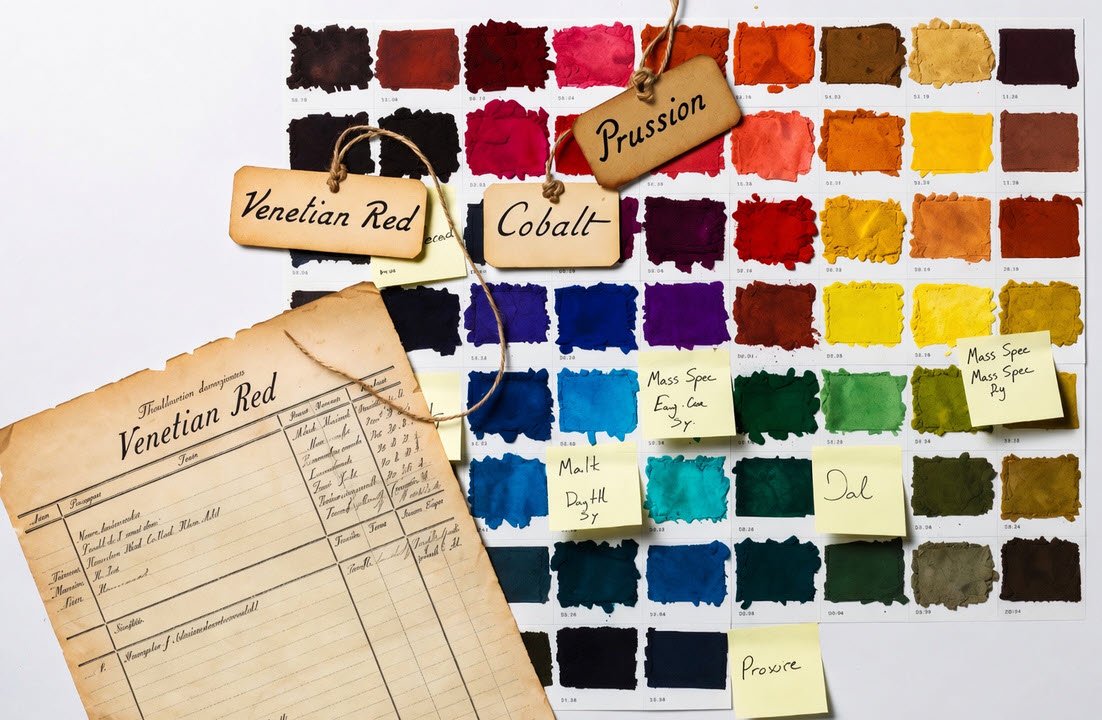
Writing a statement that survives scrutiny
The practical form follows directly from the five entities. A statement should make clear which one it is about, and where it moves between them it should say what carried it across.
Of a term: give the word, its language, the source, the date and the passage. Of a substance: describe the composition and say how it is known. Of a preparation: describe the process and the evidence for it. Of a product: name the supplier, grade, date and market as far as they are known. Of an object assertion: name the work, the location within it, the method, the result and the confidence.
Where the evidence stops, the sentence should stop. A term whose referent cannot be resolved is recorded as an unresolved term, which is a genuine finding and often a more useful one than a guess. Nilpar Gallery records take this form deliberately: they use the broad functional class when the narrower one is not supported, and they write down the gap rather than fill it.
The payoff is not caution for its own sake. A record built this way remains usable when new analysis arrives, because the layers can be updated independently — a term can be resolved without rewriting the object assertions, and an object assertion can be revised without unsettling the terminology. A record that collapses the layers into a single confident sentence has to be rebuilt from the beginning, and usually isn’t.