
.jpeg)
Gilding is a family of systems
Gilding is often described as a single finish. In practice, the word covers several surface-covering systems using gold, gold alloys or visually similar materials as leaf, foil, powder, bound particulate material or later coating.
The first useful question is not simply whether a surface is gilded. It is:
Which metallic or effect material, in what physical form, attached by which system, over what preparation, and altered by which finishing or later intervention?
A controlled description keeps those entities separate. Elemental gold, a gold alloy, imitation leaf, bronze powder and a mica-based effect pigment may produce related appearances while differing greatly in composition, corrosion response, adhesion, ageing and treatment sensitivity.
Material identity and material form are separate
A gold-coloured surface may contain elemental gold, a gold alloy, silver, tin, copper-zinc alloy, aluminium, coated mica or another effect material. Appearance alone cannot establish composition.
Physical form creates another distinction. Leaf and foil are sheet materials. Powder and metallic pigment are particulate. Shell gold is a bound particulate-gold preparation applied like paint. A commercial “gold paint” may contain genuine gold, imitation metal or a non-metallic effect pigment.
A useful record therefore states both identity and form: genuine or imitation material; elemental composition or alloy where supported; loose or transfer leaf; foil, powder or paint; and the exact product where relevant. The word gold on a label is not enough.
A gilded surface is a layered construction
The visible metal may be the thinnest component in the system. Beneath it can lie a support, seal or size, mineral ground, raised preparation, bole, mordant or other adhesive layer. Above it may be tooling, toning, glazing, varnish, later repair or regilding.
These layers do not form one universal sequence. Manuscript illumination, panel painting, gilded frames, architecture and contemporary mixed media can use different constructions. Terms such as gesso, bole, ground, size, mordant, binder, and varnish identify different materials, functions, or positions,, and varnish identify different materials, functions, or positions, even when a product performs more than one role.
Recording the layer order matters because cracking, detachment, abrasion or colour change may originate beneath or above the metal rather than in the metal itself.
Technique names require bounded definitions
Water gilding generally refers to leaf applied over a water-responsive preparation and may support burnishing. Oil or mordant gilding attaches leaf to a prepared adhesive layer. Manuscript gilding may use leaf, particulate gold or raised preparations. Powdered-gold application forms a binder-containing layer rather than a continuous metal sheet.
These are families of techniques, not fixed recipes. Workshop practice, historical terminology and product language vary. Persian manuscript and Tazhib gilding must be described by period, object, workshop and evidence rather than compressed into one inherited method.
Hazardous historical processes, including mercury-amalgam gilding, belong only to historical and analytical discussion. Their existence does not justify operational reconstruction.
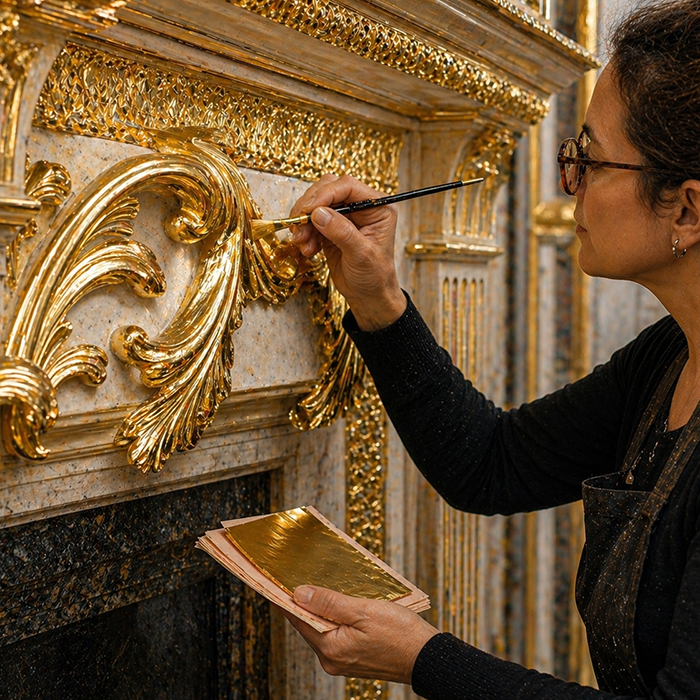
Finishing changes the optical result
Burnishing smooths and compresses a suitable gilded surface, increasing directional reflection. Matting creates or preserves a softer response. Punching, incising, stippling and other tooling break the surface and organise reflected light.
Alloy, leaf thickness, ground colour, texture, overlaps and coatings also affect appearance. Warm colour does not prove a copper-rich alloy, and a matte surface does not prove particulate application. Technical examination may be required.
Microscopy can reveal joins, overlaps, particles and tooling. Cross-sections can show local layer structure. Elemental methods can identify gold and alloying elements, but thin leaf allows underlying layers to contribute to the signal. No single result establishes form, date, originality or authorship.
Ageing and later intervention must remain visible
Gold itself can be comparatively resistant, but gilded systems include adhesives, grounds, alloying metals, imitation materials and coatings that may corrode, discolour, soften, crack or detach. Thin leaf is also vulnerable to abrasion.
Later varnish, toning, overpaint, overgilding and regilding can substantially alter the original surface. Detecting gold does not prove that it is original or reveal whether it was applied as leaf or powder.
A responsible record names the support and preparation, metallic identity and form, technique, finish, coatings, repairs and uncertainties. The taxonomy organises evidence; it does not authenticate an object or provide a universal gilding procedure.