
Art History
A Brief History of Persian Illumination (Tazhib)
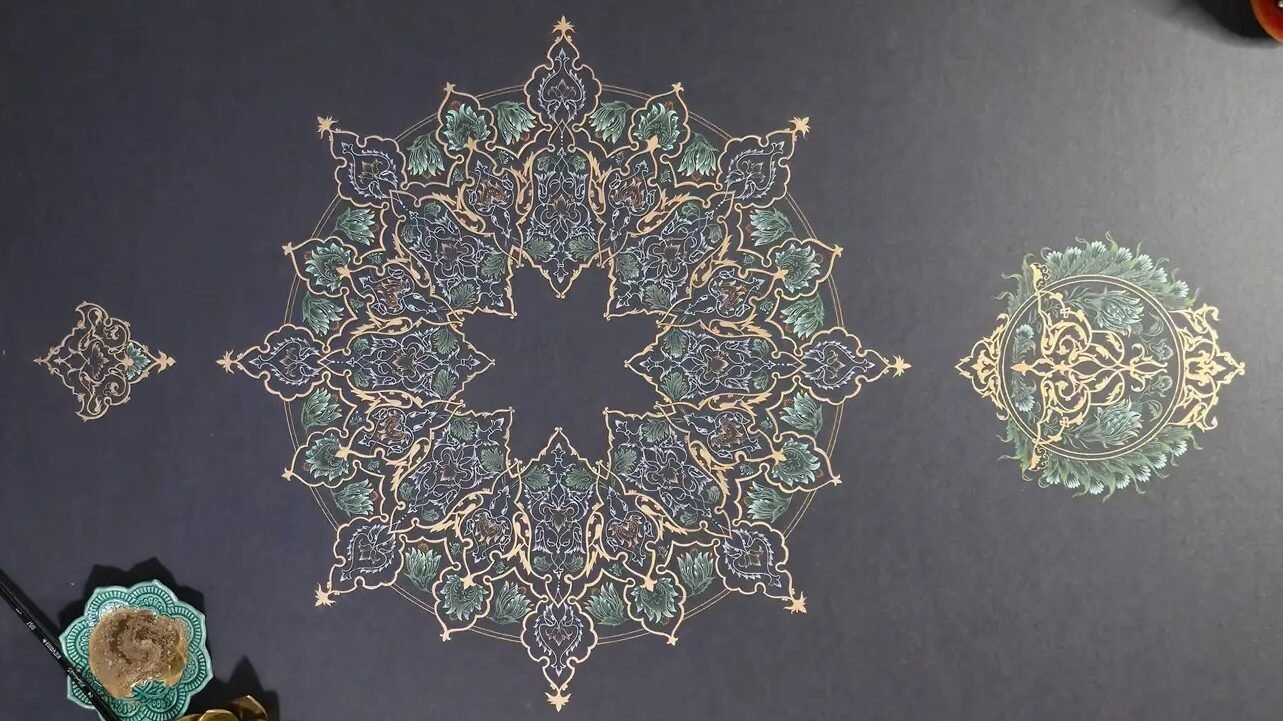
Persian illumination, known as Tazhib, is an art of light. Neither illustration nor ornament alone, it is a disciplined visual language developed to frame words, mark thresholds, and guide attention toward meaning. For over a millennium, Tazhib has shaped how sacred and poetic texts are encountered quietly, patiently, and with reverence. Today, its logic continues to inform contemporary Persian art practices, including those presented by Nilpar Gallery.
Historical Context
The roots of tazhib reach back to pre‑Islamic Iran, particularly the Sassanian period, where royal manuscripts and courtly objects already displayed a refined sense of vegetal rhythm, symmetry, and precious materials. While these early forms were not yet “illumination” in the later Islamic sense, they established a visual grammar of order and radiance that would persist.
Following the 7th‑century Islamic transformation of Iran, manuscript culture expanded dramatically. As figurative imagery became limited within religious contexts, artistic energy turned toward abstraction: geometry, vegetal scrolls, and calligraphic framing. Illumination emerged as a means of honouring the written word, especially the Qur’an, without competing with it.
By the Timurid period (14th–15th centuries), Persian illumination reached one of its most celebrated phases. Royal workshops in cities such as Herat produced manuscripts of extraordinary refinement. Gold grounds were balanced with lapis blues, delicate reds, and carefully proportioned symmetry. At this moment, Tazhib was inseparable from calligraphy, binding, and paper-making: a fully integrated art of the book.
The Safavid era (16th–17th centuries) extended and enriched this tradition. Illuminators developed increasingly complex compositions, including the shamsa (radiant sunburst medallion), elaborate marginal decorations, and more saturated colour palettes. Illumination was no longer confined to sacred texts alone; poetry, historical chronicles, and royal albums all received tazhib, reflecting the broader cultural prestige of the art.
Thematic and Formal Language of Tazhib
At its core, tazhib is governed by a non-figurative structure. Its motifs are drawn from three interrelated systems:
- Geometric frameworks establish proportion, balance, and visual stability.
- Vegetal and arabesque forms, suggesting growth, continuity, and breath.
- Radiant centres and borders, marking beginnings, endings, and moments of emphasis.
Gold is not merely decorative. In Persian illumination, it functions as light itself, activating the page, guiding the eye, and creating pauses within reading. Importantly, tazhib does not narrate. It prepares the viewer for contemplation, acting as a visual threshold rather than a story.
Material History
Traditional tazhib relies on a demanding material vocabulary. Pure gold, often ground or beaten into leaf, provides luminosity and permanence. Natural pigments such as lapis lazuli for blue, organic reds, earth colours, and plant-based yellows were chosen not only for beauty but for symbolic resonance and stability.
Illuminators worked primarily with water-based binders, producing surfaces that required absolute control. Each layer demanded drying, burnishing, and correction. The craft rewarded patience; a single illuminated opening could take weeks or months to complete. The result was an art form inseparable from time, discipline, and restraint.
Continuity into Contemporary Practice
Although no longer central to manuscript production, tazhib has not disappeared. It survives through master–apprentice lineages, conservation workshops, and contemporary reinterpretations. Many artists today extract their principles rather than replicate their forms: symmetry without rigidity, ornament as structure, gold as presence rather than excess.
Within contemporary Persian art, illumination often migrates from the page to independent works on paper. The logic of framing, repetition, and radiance remains, but is freed from textual obligation. This shift allows tazhib to function as a living visual language rather than a historical style.
At Nilpar Gallery, this continuity is explicit. Contemporary works in gouache and gold on handmade paper draw directly from the discipline of illumination while speaking in a present tense. Pattern is treated not as decoration, but as cultural intelligence, an inheritance carried forward with care.
A Collector’s Perspective
Understanding tazhib deepens how contemporary Persian artworks are read. For collectors, illumination provides context: why gold behaves as light rather than luxury; why pattern invites slow looking; why restraint often signals mastery.
Tazhib also reassures longevity. Its materials, methods, and philosophy were developed for endurance, both physical and cultural. When encountered within contemporary practice, illumination offers continuity without nostalgia: a conversation across centuries, held quietly on paper.
Media Placement Notes
Full manuscript opening featuring Timurid or Safavid illumination. Detailed image of the shamsa motif in gold and blue. Contemporary Nilpar artwork detail showing gold application on handmade paper
Suggested Alt Text for Images
“Timurid Persian manuscript illumination with gold and lapis detailing”,
“Safavid shamsa motif in gold illumination”,
“Contemporary Persian gouache and gold painting on handmade paper, Nilpar Gallery”