
Pigment History
The Oldest Darkness: A History of Black Pigments
Black was the first pigment. Before any colour was ground, mixed, or traded, there was soot on the wall of a cave and charcoal in the hand that put it there. The history of black pigment is, in one sense, the history of painting itself, because every other colour arrived after this one. And unlike the blues, reds, and yellows that have come and gone with the rise and fall of trade routes, black has never been absent from the palette. It has simply changed its source.
What makes this constancy remarkable is not sentiment but chemistry. Carbon, the element at the heart of nearly every historic black, is among the most light-stable materials a painter can use. A stroke of lamp black applied to papyrus four thousand years ago remains legible today. The question, then, is not whether black endures. It is which black, made from what, and how its character shifts from origin to origin.
The First Blacks: Charcoal and Soot
The earliest known uses of black pigment date to the Upper Palaeolithic. Charcoal from burnt wood and bone was used to outline the animals at Lascaux and Chauvet, applied directly or ground and mixed with animal fat. These marks survive not because they were protected, though cave conditions helped, but because carbon is inherently resistant to the chemical degradation that destroys organic dyes and many mineral pigments.
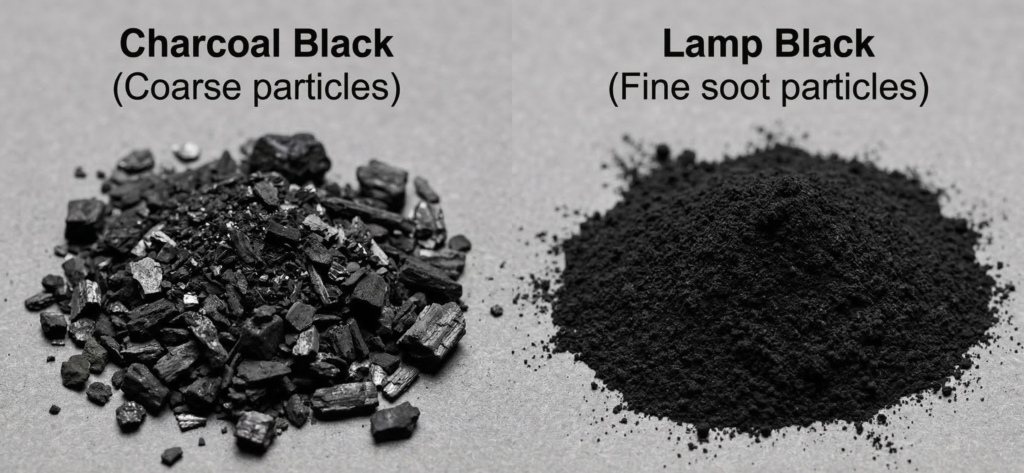
Charcoal black, produced by burning wood in limited oxygen, retains some of the cellular structure of its source material. This gives it a slightly gritty texture and a warm, sometimes brownish undertone. The choice of wood matters. Willow charcoal, still used for drawing, is softer and cooler in tone. Vine black, made from charred grapevine stems, was prized for centuries for its deep, slightly blue-black character. The Flemish painters valued it for the purity of the cool greys it produced when mixed with lead white, and it remained in use well into the nineteenth century.
Soot-based blacks followed a different logic. Where charcoal is made by destroying wood, lamp black is made by collecting what fire releases. Oil, resin, or fat is burned under controlled conditions, and the soot that deposits on a cold surface above the flame is scraped off and gathered. The resulting pigment is nearly pure amorphous carbon, with particles far finer and more uniform than charcoal. This fineness gives lamp black a velvety, slightly cool quality and a remarkable tinting strength.
From Bone to Ivory: The Animal Blacks
Not all historic blacks are pure carbon. Bone black, produced by charring animal bones in a sealed vessel to prevent full combustion, contains only ten to twenty per cent carbon. The remainder is calcium phosphate, the mineral component of bone that survives the heat. This composition gives bone black a warmer, slightly brownish undertone and a lower tinting strength than lamp black or carbon black. In thin washes, this warmth becomes visible, shifting toward yellow-brown rather than the neutral grey of a purer carbon.
Bone black has been identified in Egyptian, Greek, and Roman art, and it was used throughout the medieval period. Medieval artisans refined the process by washing and filtering the charred material and grinding it finer on a stone slab, which increased the depth of the colour. The pigment known historically as ivory black was made by the same process from actual ivory, which, being denser and harder than common bone, produced a finer, deeper black. The ancient Greek painter Apelles is credited with developing a variant by collecting the soot of burnt ivory tusks. By the eighteenth century, the distinction between ivory black and bone black had largely collapsed. Commercial bone black was produced in vast quantities as a by-product of the glue and sugar-refining industries, and genuine ivory black became increasingly scarce. Today, what is sold as ivory black is almost always bone black, sometimes with added carbon to deepen the colour. The ivory trade, rightly outlawed, ended any pretence of distinction.
In Persian manuscript illumination, carbon-based blacks were the standard. Raman spectroscopy analyses of sixteenth- and seventeenth-century Persian manuscripts have consistently identified carbon black as the primary black pigment, used for ink, outlines, and fine detail work. Some manuscripts also show evidence of bone black. Persian treatises on painting technique describe producing black from carbon soot and bone mixed with gum, a formula that aligns precisely with what conservation science has confirmed. The black ink of a Qajar-era Qur’an and the outlining in a Safavid miniature share, at the molecular level, the same ancient material.
The East Asian Refinement: Ink as Civilisation
If the West treated black pigment as one colour among many, East Asia elevated it to the foundation of an entire artistic and literary culture. Chinese ink, made from soot bound with animal glue, has been in continuous production for over two thousand years. Archaeological evidence from tombs dating to the end of the Warring States period, around 256 BCE, has yielded physical ink pellets, and ink traces on artefacts suggest the material was in use considerably earlier.
The Chinese system distinguished between two types of soot. Pine soot, made by burning pinewood in purpose-built kilns, produced particles of varying size and gave an ink that ranged from dense black to a bluish grey depending on dilution. Oil soot, or lamp black, made by burning tung oil or other vegetable oils, produced finer, more uniform particles and an ink with greater lustre and depth. By the seventeenth century, one source estimated that nine-tenths of Chinese ink production used pine soot, though modern manufacture has shifted toward oil soot for its consistency and ease of control.
The binding agent was animal glue, typically collagen extracted from hides, and the manufacturing process was extraordinarily rigorous. The soot and glue were mixed into a paste and kneaded thousands of times. The resulting dough was pressed into moulds and dried slowly, sometimes for months or years, to produce the solid inkstick. Quality was judged by the smoothness of the grinding action on the inkstone, the depth and lustre of the black, and the absence of noise during preparation.
[IMAGE STRATEGY: A still-life arrangement of a traditional Chinese inkstick, an inkstone with a small pool of freshly ground ink, and a calligraphy brush resting alongside, photographed in soft natural light to show the glossy surface of the inkstick and the liquid depth of the prepared ink. Alt-text: A rectangular Chinese inkstick with gold-stamped characters resting beside a dark stone inkstone with a shallow pool of freshly ground black ink, a bamboo-handled calligraphy brush laid alongside, lit by diffused natural light.]
What makes this tradition relevant beyond its cultural beauty is its proof of longevity. Chinese ink has proved to be one of the most stable painting materials in existence. The carbon pigment is extremely lightfast, the fine particle size ensures deep penetration into paper or silk, and the animal glue binder, once dried, is mechanically robust. Manuscripts and paintings executed in this medium over a thousand years ago retain their density and legibility. The formula is, in essence, lamp black and collagen, and it works.
The Modern Blacks: Mars Black and Synthetic Carbon
The twentieth century introduced a fundamentally different kind of black to the palette. Mars black, a synthetic iron oxide, belongs to the Mars family of pigments developed as alternatives to natural earth colours. Unlike every black discussed so far, it contains no carbon at all. It is made by reacting iron sulphate with an alkali, producing a fine iron oxide with a smaller, more consistent particle size than natural magnetite.
Mars black brought practical advantages that appealed to modern painters. It dries significantly faster than carbon-based blacks, making it better suited to underpainting. It is highly opaque and has strong tinting strength. Its undertone is warm, and it handles well on the brush. For artists working in oil or acrylic at speed, these properties made it a compelling choice.
At the same time, industrial carbon black production advanced enormously. Modern carbon black, classified under the pigment index as PBk7, is produced by the incomplete combustion of natural gas or petroleum products under controlled conditions. The result is a pigment of extreme fineness, high opacity, and excellent lightfastness, more consistent than any historically produced lamp black or charcoal could be. PBk7 has largely replaced traditional carbon blacks in commercial paint manufacture, though artisanal lamp black and vine black remain available for painters who value their specific tonal qualities.
The Pigment Properties Compared
| Historic Pigment | Origin & Nature | Opacity/Transparency | Behaviour in Gouache |
|---|---|---|---|
| Lamp black (PBk6) | Soot from burning oil or resin; nearly pure amorphous carbon | Semi-opaque to opaque; high tinting strength | Smooth, velvety application; cool, slightly bluish undertone in tints with white; excellent lightfastness (ASTM I); slow drying |
| Vine black (PBk8) | Charred grapevine stems; impure carbon retaining plant structure | Semi-transparent to semi-opaque; moderate tinting strength | Slightly gritty texture; deep blue-black in masstone; produces cool, clean greys; excellent lightfastness; good for glazing |
| Bone/ivory black (PBk9) | Charred animal bone; 10-20% carbon, remainder calcium phosphate | Semi-opaque to semi-transparent; lower tinting strength than lamp black | Warm, yellowish-brown undertone visible in thin washes and tints; granulating quality in watercolour; excellent lightfastness; rewettable |
| Carbon black (PBk7) | Modern industrial combustion of gas or petroleum; nearly pure carbon | Highly opaque; very high tinting strength | Dense, neutral black; fine particles give smooth coverage; can overwhelm other colours in mixes; excellent lightfastness (ASTM I) |
| Mars black (PBk11) | Synthetic iron oxide; no carbon content | Highly opaque; strong tinting strength | Warm undertone; dries faster than carbon blacks; granulating in watercolour; excellent lightfastness; good for underpainting |
Black in the Illuminator’s Hand
In the context of Nilpar Gallery’s practice, black serves a precise structural function. It is the pigment of outline, of the fine contour lines that define and separate the fields of colour and gold in a work of Tazhib. Where the lapis ground meets the gold leaf, where the Eslimi scroll bifurcates and curls, where the Khatai bloom resolves its petals, black is the line that articulates the boundary.
The choice of black in this context is not arbitrary. A carbon-based black, whether lamp black or bone black, bound in gum arabic, is chemically inert against the other pigments it touches. It does not react with gold. It does not shift the colour of an adjacent vermillion or lapis lazuli field. It is, in conservation terms, a neutral neighbour, and this neutrality is part of its value. The lightfastness of carbon blacks is among the highest of any pigment class, rated ASTM I across virtually all formulations. In a work designed to endure, the darkest element on the surface may well be the most stable.
[IMAGE STRATEGY: A close-up of fine black outlines in a Tazhib composition, showing where the carbon-based ink delineates the boundary between a gold-leaf field and a deep blue gouache ground, the precision of the line visible at magnification. Alt-text: Magnified detail of a Persian illumination showing a fine black outline separating a burnished gold-leaf area from a deep ultramarine blue gouache field, the line crisp and unbroken against both surfaces.]
There is something fitting in this. The oldest pigment, the one that has been with us since the first mark on stone, is also the one that holds the composition together. In a medium where gold catches light and colour saturates the field, black does the quiet work of structure. It draws the edge. It defines the form. And it endures longer than almost anything around it.